Tuesday, May 19, 2015

Digitising LPs and Cassettes


All the images will enlarge when clicked.
 
People of my age were raised on recorded music that was available in two mediums (or 'media', if you are pedantic!): vinyl records and the later cassette tapes.
When CDs came into vogue (circa 1983 here in Australia) the three formats ran side-by side for some years until first vinyl records (45s and LPs) were phased out then, much more recently, the cassette tape disappeared.

So the population gradually changed over to CDs, building up a new library but in the meantime the LPs were rarely played and ended up gathering dust in the corner of the living room and the stereo-system made way for a new system that featured a CD player in place of the turn-table.

Roll the clock forward to the 21st. century and the evolution of computer technology and we now have a situation where those old recordings - vinyl and cassettes - can be played, recorded, converted into digital format and more than 2000 individual songs stored in such a way that they can be carried in a shirt pocket in the form of an eight-gigabyte USB stick.

Over the past few months I've been doing exactly that for people who have dusty LPs and cassettes that have not been played for years.
Those people are now able to listen once again to the favourite music from their younger years and can do so in the home, in the car, when travelling on public transport or when out-and-about cycling, walking, hiking, climbing mountains or jumping off cliffs!

Many folk have asked me how this process is carried out, so I thought I'd give a thumbnail description as follows below.

Firstly, it's necessary to play the record (or cassette) and record the tracks whilst it is playing.
One minute of playing time equates to exactly one minute of recording time; there is no shortcut.

So the record is popped onto the turntable (or the cassette into a special USB-output cassette player).

I prefer to use a Dual 1229 turntable from the 1970s, which had a very good reputation for quality output and accurate speed and mine is fitted with the type of Shure cartridge and stylus recommended by the manufacturer back in the day.

I use the Dual if I am planning on doing something else whilst the record is playing because I can walk away and leave it, knowing that it will shut off (and the recording software on the computer will do likewise) when the record has finished playing.
The output of the turntable is connected to that little black box in the corner......
This device takes the analog signal coming from the record and passes it in digital format to the software used on the computer via a USB outlet in the NAD and a corresponding port on the PC.

At the same time I also take a feed out of the NAD device to the stereo amplifier seen in the first photograph, in this case a lovely 1970s Pioneer SX-750 which has given me excellent service for the past decade.
I don't need to do this but sometimes I just play a record for the sake of listening to a record, so it's easy to have a permanent connection to the stereo system

If I don't have anything else to do whilst a record is being digitised and if I'm happy to pick up the arm when the record comes to the end, I may use the Pro-Ject Genie turntable seen below............
This is a manual unit, where the arm is picked up and placed on the record and then manually removed when the record comes to the end of the last track, and features the recommended Ortofon cartridge and stylus.

Irrespective of which turntable is used, once a side has been played and recorded the LP is flipped over and the same procedure gets underway for the second side.
This technique also applies to cassettes.

The software program (Vinyl Studio) displays details about the record/cassette, which are input by the user.

Once recording is finished the saved digital file is taken into another program (Audacity) for editing.
Many records have accumulated dust and scratches over the years which result in "pops and clicks" being evident in the playback.
With an editing suite it is surprising how many of these extraneous noises can be removed without otherwise affecting the quality of the recording.

The editing program displays the recording as a linear graph........

The start of the record is at the extreme left-hand side, the long "lumps" are the tracks (in this example there are six) and the short, narrow bits are the transitions between one track and the next on the record.
This example also shows that the record (Paul Mauriat's "Mauriat Magic") was in stereo - the top trace is the left channel and the bottom trace is the right channel.
If you look closely you may also see several spikes - single straight lines - which project from the tracks.
These are sharp noises most often due to damage and or dirt in the track and are usually capable of being removed.
I will run the recorded file through a filter, selectable in the software, to remove the noises above a certain level.
Once filtered I then break the recording into its separate tracks, naming each one exactly as they are named on the LP (or cassette), and save them as individual MP3 files.

Then the last step is ready to place in operation and that is burning a CD, for which yet another computer program (Sonic) is used..............

This allows the CD to be created as either a conventional audio CD or one which is played in a computer.
The edited files are taken into the program, a CD placed into the CD drive and ten minutes later out comes a modern recording of an LP last played 30 years ago.

If the owner prefers to have the files stored on a USB stick rather than burned to a CD then the final step is much faster as it then just becomes a simple matter of copying the files across to the stick - in essence, just another minute or so.

To digitise an LP (or cassette) from go to whoa can take around an hour, sometimes longer if there are more than six tracks per side (or more than 30 minutes per side for a cassette).

It's an interest that I enjoy doing; it's very rewarding seeing the smiles when people know that they can once again listen to their favourite recordings.

And it keeps me off the streets.

Monday, May 18, 2015

A Mother's Day photo.

The photograph below was taken on Mother's Day, when grandson Fin would have been about four month's old.


Parenthood certainly appears to suit Amy and Drew.

Friday, May 8, 2015

Winter's nearly here.

It was a cool day in Yamba today and also yesterday, with temperatures down to about 24 maximum.....maybe a degree lower. Clear skies and bright sunshine, however.

But down in Tasmania (and Victoria) it was a different world; winter arrived with a blizzard in the Victorian alps and in Tassie it was just as bleak.
This photo - sent to my sister by a friend in Hobart - could be from somewhere in Europe rather than Mount Wellington, behind the city.
The building is the iconic Cascade brewery - the original structure.
A lovely photo, what with the snow dusting the mountains and the old building bathed in sunlight.

Tuesday, April 28, 2015

ANZAC Day - 100th. Commemoration

The 25th. of April 2015 marked a century since the landings in the Dardenelles by British, French, Australian and New Zealand troops.
In commemoration and remembrance of that day, the local theatrical group presented a special one-hundredth anniversary performance at the Maclean Civic Centre.

Below are some photographs taken during that performance.
I don't know the names of the performers, other than that of my sister, but I'm sure that the participants, their family and friends will be able to pick out faces in the cast.

All photos will enlarge when clicked.

The full ensemble.


"Kiss Me Goodnight, Sergeant Major"


"I'm Gonna Wash That Man Right Out Of My Hair", from South Pacific.


Members of the cast in the finale.


A selection of favourite songs from WW1 and WW2.


The female prisoners' choir.


The finale.


A wonderful performance by a lot of very talented - and dedicated - people.

Saturday, April 18, 2015

Summer is fading and Autumn is here.....

.....but you wouldn't really know.

The weather over the past fortnight has been superb - clear, blue skies, gentle southerly breezes, low humidity and temperatures in the 24 -27 degree range.
This is Autumn far-north coast style and significantly different to that we experienced in Canberra: the trees don't becomes masses of golds and reds and then lose their leaves, the shrubs and garden beds still bloom, everyone still wears shorts and T-shirts, the beaches are still peopled and the only significant change is a single blanket now pulled up at night.

It's hard to believe that exactly 12 month's ago we exchanged contracts and were counting down to the 16th. of  May, the date that we left Canberra's cold and moved to Yamba.

Rosie the cat likes it in the afternoons now,  when the sun is low enough to shine through the living-room window and warm the end of the lounge suite for an hour.....
Aaaah! It's a rotten life but some cats just have to put up with it.

Meanwhile, out the back in the sweat-shop.......
Shirley continues to sew up weight bags for the residents' exercise classes at the local nursing home.
Sometimes the language that comes from this part of the premises leaves something to be desired!

Monday, February 16, 2015

Tiger Feet and Kitchen Stools

Since living on the far-north coast for over nine months (moved last May from Canberra) I have worn little other than shorts/swimmers, Hawaiian shirts and, on my feet, Birkenstock sandals.

The climate has had its effect; all my life I've tanned easily, turning nut-brown in summer as a child. Back in those days summertime was spent in shorts and little else...not even a top.
So I had to have a laugh when I noticed my feet the other day......no, they aren't dirty stripes but suntan through the gaps between the straps on the Birkies.
Ugly feet, but nice sandals.
I can recommend them for comfort, support and, of course, striped tanning!

The other item in this update relates to the two wooden stools that my wife made for our breakfast bar.

She did all the work, using the power tool equipment available at the Men's (and Women's) Shed located at Townsend, near Maclean.
Timber is (I think) Meranti and all the joints were doweled and glued and the timbers stained and varnished.
The corduroy seat-pads were done by a professional upholsterer using materials supplied by my wife.
Very comfortable items and beautifully made.

Wednesday, January 14, 2015

A new arrival

We became grandparents for the third time just two days ago with the arrival of out new grandson, Fin Robin, the first for my son Drew and his partner, Amy.

"Fin" (which may also be spelt "Finn") is ancient Scottish and means " blonde-haired warrior".

As I will turn 70 at the end of this year I can't help but wonder what the world will be like for little Fin and his generation in another seventy year's time - 2085. I hope that it is a happy place.

UPDATE Sunday 25th. January
We visited out new grandson in Brisbane yesterday and naturally I took several photos.
I think that the one below, with Fin being held by his paternal grandmother, is the pick of them.


Wednesday, December 31, 2014

The calm after the storm

A couple of photos taken after a late afternoon storm passed through a few days ago and the setting sun lit up the clouds.
The first is a panoramic and both enlarge when clicked.


Friday, December 19, 2014

Yamba from the air - and stormy weather.

Here's an aerial view of Yamba.............
That's Whiting Beach in the right foreground, Turner's Beach at the left.
Behind Whiting is the Yamba harbour and the village proper.

You can make out the lighthouse on the grassy headland, the reservoir and, in the background, Main Beach, Convent Beach and Pippi Beach, which runs down to Angourie.

A lovely photo, taken by I know not whom.

Last week we had a very stormy day, with strong winds and high seas.
Here are a few shots taken from the lighthouse looking down at the breakwater.


This was the same day that a yacht off the coast near Evans Head (up the coast a little way from Yamba) sent out a mayday after hitting a submerged object and foundering. They were rescued by a freighter and everyone was okay.

Tuesday, December 9, 2014

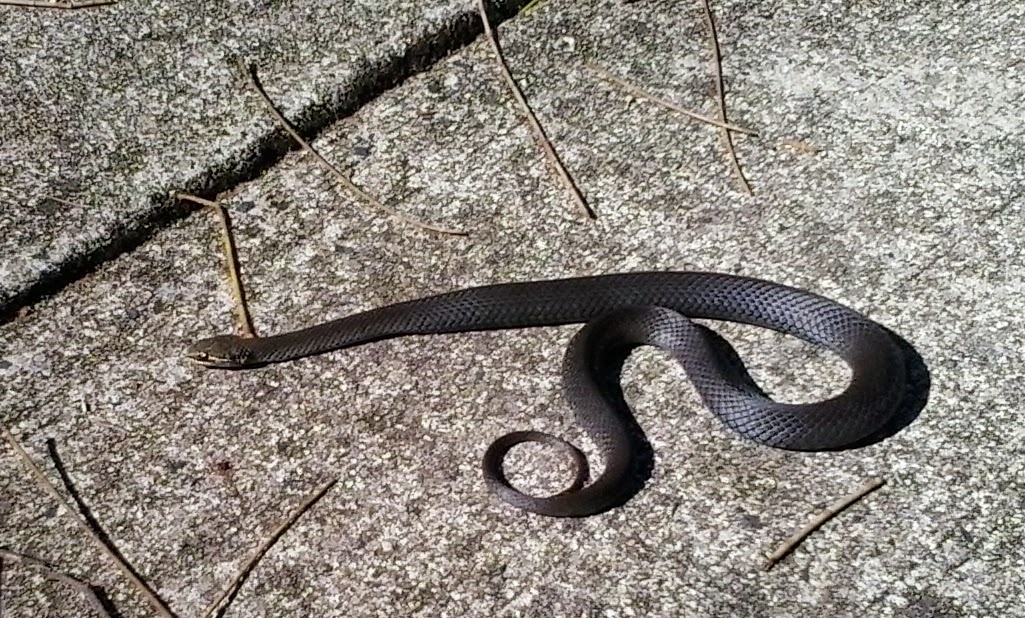
Hemiaspis Signata

In other words, the "Marsh Snake".


I came across this little bloke this morning, on the footpath which runs through the glade of trees in the resort.

He/she was about 20 cm long and didn't even move when I gently picked it up.....with a thin stick!
I popped it back down on the path, took a couple of photos and then when I was back home I used them to identify the snake.

First snake I've seen in the "wild" for decades; the last one was an "Eastern Brown" snake in Canberra about 30 years ago - I nearly stepped on it!